
Interview with Councillor Emily Kerr
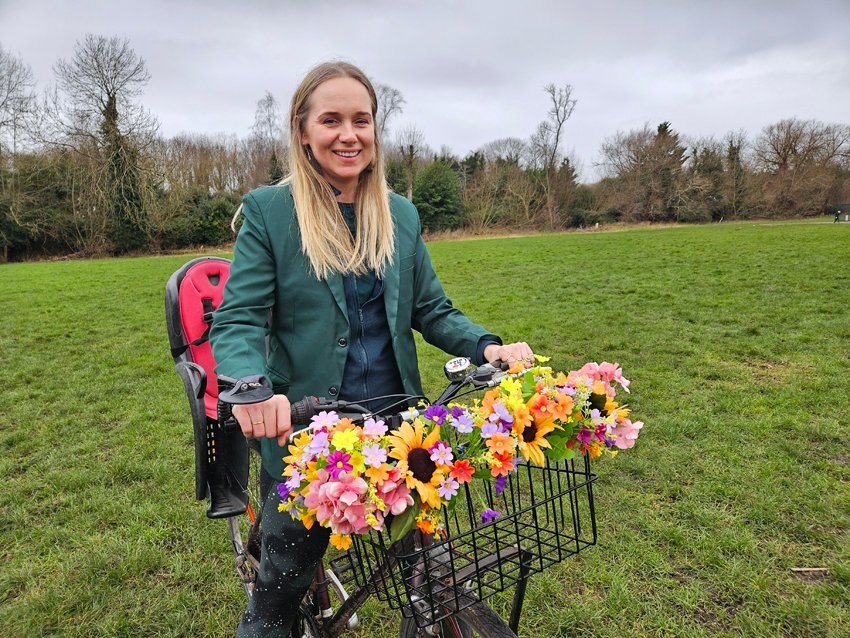
Emily is Active Transport Champion for Oxfordshire
Emily was interviewed by Richard Scrase about her role as Active Transport Champion. You can listen to the interview here (edited by Phoebe Hardcastle):
Below is a transcript.
Why did you take on the role of active travel champion?
I’m passionate about getting more people able to walk and cycle and indeed horse ride, which my role now covers, and just getting people out and fit and able to travel independently, particularly children around their own city and their county in an easy way. I’ve long campaigned on safer streets. If we want streets to be safer, we need more people to switch away from private cars and into walking, cycling and buses.
What does the role entail on a day-to-day basis?
Maybe this week’s a good one to look at. I’m going out to visit a market town, Witney, tomorrow. I have been working on a policy this morning. I am going to look at a couple of future planned greenways routes. I feel familiar with the greenways program around Oxford. It’s the idea of improving travel into the city along specific corridor routes. I’ve got a full day workshop on one of the greenways and what that might look like. And I have also got a couple of things that I’m looking at on Vision Zero specifically.
Can you explain what Vision Zero is?
Vision Zero is an idea adopted from other countries, specifically, Finland and Norway, that we should tolerate no killed or seriously injured people on our roads. How do we get there now Oxfordshire has adopted this target? It’s complicated, it’s what we call a safe systems approach. We need to change infrastructure, which is a multi-year program. We need to change driving behaviour. We need to change enforcement. There’s a whole load of different agencies working together on this, but all with the same vision of zero killed or seriously injured people on Oxfordshire roads.
Does your role have any particular legal responsibilities?
I hope not is the honest answer to that. I don’t have any specific legal training. I give my viewpoints as an active travel champion. I am not a member of the administration. I have been asked to look at this by the administration, the Lib Dem cabinet, but I’m not a cabinet member. I do not have executive powers, so my role is advisory.
What are Oxfordshire County Council’s priorities for active travel?
We want to switch away 25% of car trips by 2030. I think one of the things that I’ve really learned since being elected in May, is quite how much Oxfordshire doesn’t control because of what central government prioritises. Funding constraints are huge within the council, and what we don’t have is a whole load of money swashing around to just do whatever we want. In terms of strategic priorities, yes, climate benefits, health benefits, safety benefits of switching to active travel remain absolutely key priorities for Oxfordshire.
How do you engage with the public, schools and businesses and groups like Cyclox?
I go out to various market towns and I tend to talk to local advocacy groups. I’ll also let local councillors or the local mayor, if there is one, know if I’m coming to visit. I tend to reach out to schools when I’m specifically involved in projects that might affect them, or if they’re in my division. As it happens, I’m training to be a cycling instructor so I have been in two schools as a training cycling instructor to work with kids.
I speak to businesses within my division all the time. They tend to be retail outlets. I shop local. I live very close to my division, and I live in my ward, and so people do tend to know me, and I often talk to businesses, both those who are in favour and to those who are opposed to traffic measures and active travel. And then in terms of advocacy groups such as Cyclox, I attend the monthly roundtable, and I’m available for questions, and I tend to meet and get requests from Oxford pedestrians association or Cyclox on specific projects.
You explained that the County Council resources are limited. In our city, we’ve got four really large employers. We’ve got the two universities, we’ve got the hospitals and we’ve got the car works. Do you have any conversations with them about how they could persuade their workers to come to work by bicycle?
I have had conversations with all of them. I expect you’re familiar with the link from the river towpath to Osney Mead, which the university contributed money towards and design costs towards, along with the County Council. It was a terrible track, now it’s this beautiful path. I engaged with senior management at the car plant when they were looking at a redevelopment, because the cycle path out to Horspath was involved. I also discussed it in planning committee. I talk quite a lot to schools about staff travel. Christ Church Cathedral School has basically converted their staff car parking into child play space. It’s an amazing initiative. I tend to ask schools what have you done already? Often, they will have tried something but maybe haven’t tried their initiatives consistently. I think a lot of the advocacy work you do as a champion y is just showing that there are alternatives. How can we help people car share? How can we help people cycle some days of the week, and so on.
What role do you see for shared bikes provided by companies like Voi and Lime in increasing cycling rates?
So firstly, I am such a huge fan of Voi and Lime. I met them both earlier this week at the Vision Zero event in Broad Street. We at the Council are looking at shared bike use. We need to provide more on-highways parking for them. We need to take private car parking spaces out and put in bike spaces. I’ve just been looking at a review of the controlled parking zone in my division, and I’ve been looking at where we can do that. From talking to the operators I know they are also keen on coming to some of the bigger towns. It would be great to have them in Kidlington, in Didcot, in Abington, in Bicester.
Editor’s note: Lime currently has around 100 ebikes in Oxford and they see demand for 1,000.
How does cycling fit into the County Council’s transport strategy? Are there targets for increasing cycle journeys or reducing car use?
We’ve got targets for reducing car travel by 25% by 2030. There will be targets within specific schemes for cycling but can I give you a specific target for the county? No.
How can groups like Cyclox help get new infrastructure built?
So genuinely, I think filling in consultations is extremely helpful and important because what often happens is that you end up with not that much uptake on a consultation. Officers might have spent a long time working on a great travel plan and if it gets killed by people who don’t want it, then that’s going to make that officer less likely to want to spend time doing that in the future. So my absolute number one request would be to fill in consultations, get local people to fill in consultations, really get a sort of understanding for where things are and offer constructive solutions.
Editor’s note: The Cyclox Infrastructure Group is a team of eight to ten volunteers who meet fortnightly. Many of them have significant expertise in urban design. They respond to planning applications and meet with councillors and officers.
What role does the County Council have in increasing the number of children who cycle to school?
The council 80% funds Bikeability training in schools. I think the Bikeability goal is 80% of kids able to do Bikeability level two by the time they leave primary. The County Council disperses central government funds for this.
I want to imagine the future, a time when your role has becomes redundant. How would you imagine this County Council’s cycling infrastructure would look like?
I think in a city like Oxford, and many of the market towns, we simply do not have the space for fully separated cycling infrastructure but I love separated cycling infrastructure. I would also love to see super-highways as you have in Holland. I’d love all towns and villages in Oxfordshire to be connected. For example, at the moment we’re looking at routes to Berinsfield. There’s the idea of a leisure route, which would follow the old Roman way, and then also one fast route along the main road. Female commuter cyclists want to use routes where there are more people around and more lighting so I want routes that work for women at night, and fabulous leisure routes that anyone from 8 to 80 can use.